
The Irish question
Ireland is suddenly talking seriously about a new savings and investment account. The polite policy name is a Personal Investment Account or Savings and Investment Account. The pub-table version is simpler: should Ireland finally get its own ISA?
That is not just a niche tax nerd question. It matters because Irish households are good savers, but a lot of that money sits in cash while long-term investing still feels awkward, tax-heavy and slightly mysterious. If the Government gets this right, it could make investing feel normal. If it gets it wrong, we may end up with another well-meant scheme that ordinary people politely ignore.
Two models are getting all the attention
The UK ISA is the clean, headline-friendly option. You put money in, invest or save inside the wrapper, and returns are generally sheltered from UK income tax, dividend tax and capital gains tax. It is easy to understand, which is half the battle.
Sweden's ISK is a bit stranger, but very interesting. Investors do not file tax on every dividend, sale or capital gain. Instead, Sweden applies a standard annual tax based on the account value. That means less paperwork and fewer reasons to put off investing. The trade-off is obvious: you can pay some tax even when markets have had a rough year.
So here is the real question for Ireland: do we want the cleanest tax shelter, or the easiest investing habit?
What the chart shows
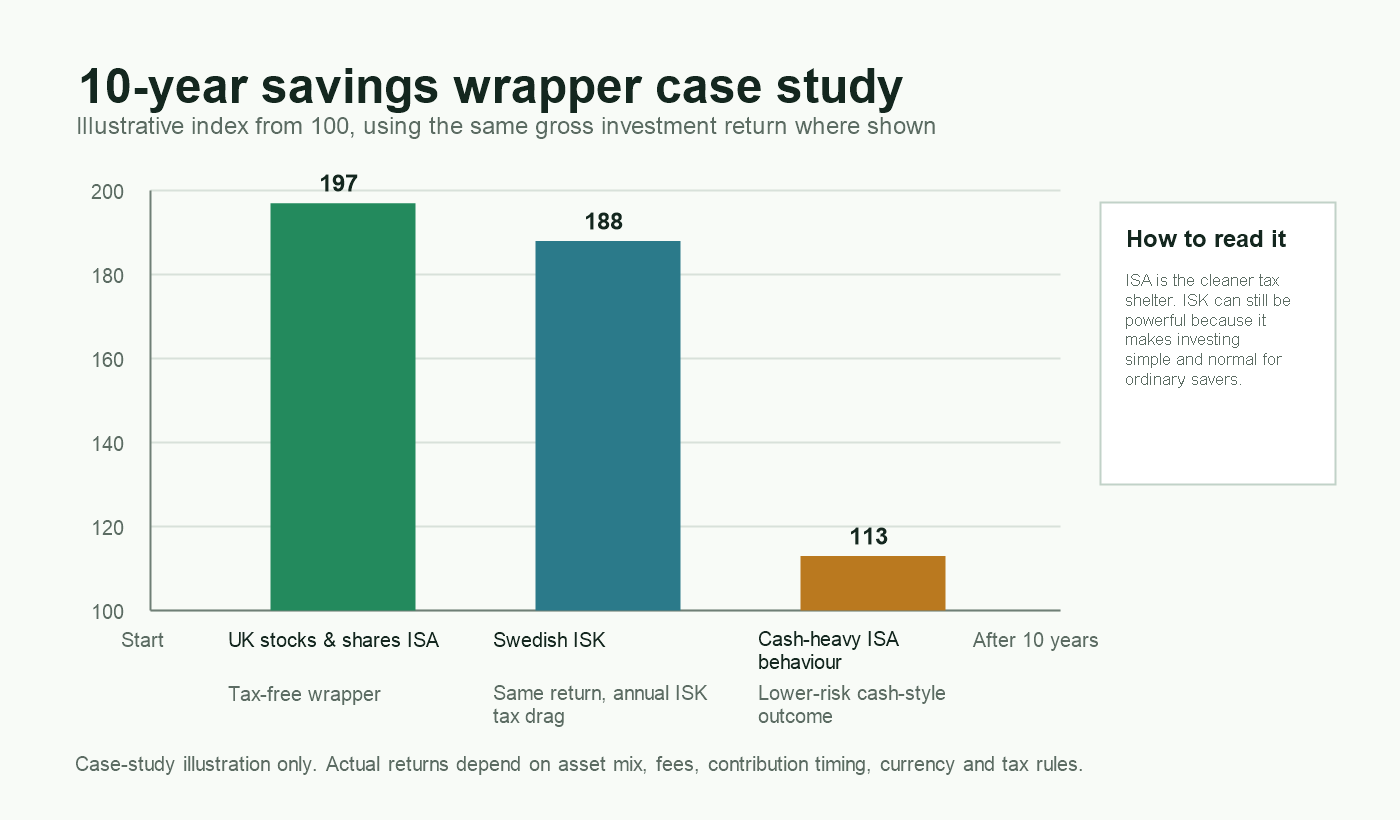
The chart uses a simple 10-year illustration starting from an index value of 100. In a like-for-like growth scenario, the UK-style ISA finishes ahead because the wrapper has no annual tax drag. The Swedish-style ISK is slightly behind because of its annual charge.
But the awkward third bar is the one Ireland should stare at. A cash-heavy saver with a tax-friendly account may still end up miles behind someone who actually invests. The magic is not just the tax treatment. It is whether the product gets people moving from cash into sensible long-term assets.
What should Ireland steal?
From the UK, Ireland should steal clarity. A simple annual allowance, broad access, no capital gains tax admin inside the wrapper, no faffing around with eight-year deemed disposal for ordinary fund investors. Make it clean enough that people can explain it in one sentence.
From Sweden, Ireland should steal the behavioural design. Easy opening. Easy switching. No tax return drama every time someone sells a fund. No sense that you need a spreadsheet, a solicitor and a quiet lie-down before buying an ETF.
The wrong answer would be the classic Irish compromise: take the name from one country, the complexity from another, add a few domestic carve-outs, and then wonder why only the already-wealthy and already-advised use it.
A sensible Irish version
The best Irish version should probably be boring in the right ways: simple limits, broad diversified investment options, provider portability, clear risk warnings, and tax handled as much as possible in the background. It should sit beside pensions, not replace them. And it should be useful to someone saving 50 euro a month as well as someone maxing out an allowance.
There is a bigger point too. Ireland does not need a flashy scheme for people who already invest. It needs a trusted front door for people who have never quite made the jump. That is where the UK ISA and Swedish ISK both have lessons. One says: make the tax answer simple. The other says: make the behaviour easy.
If Ireland can combine those two ideas, we might actually build something ordinary savers use. If we cannot, we will have invented another acronym. And Ireland has enough of those already.
Useful sources
- Department of Finance: Annual Savings and Investment Forum
- BPFI paper: A Savings and Investment Account for Ireland
- GOV.UK ISA rules
- Skatteverket ISK calculation
- Swedish Investment Fund Association ISK page
This article is educational only. The figures are illustrative and are not a forecast, tax advice or a personal recommendation.